• Hey Guest, Have an interview coming up? We’ve opened new mock interview slots this week. Book here
  • Received a training contract offer? We're hiring. It's fully remote. Apply by 27 April 2026
  • TCLA Premium: Now half price (£30/month). Applications, interviews, commercial awareness + 700+ examples.
    Join →

Jaysen does the SQE

Jaysen

Founder, TCLA
Staff member
TCLA Moderator
  • Feb 17, 2018
    4,953
    9,470
    Okay, I never thought I'd be posting my own thread, but why not.

    I'm taking SQE1 in July. You can read more about my reasons here.

    I'll use this thread to write about the process.

    What I'm hoping is I can share, in real time:
    • Advice I get about how to do well
    • Techniques I use to study
    • Things that aren't obvious
    If anyone is also taking the SQE now or in the future, you are also very welcome to start your own thread in this forum.
     
    I don't start my prep until the 27 April, but I want to use this time before to chat to people who have recently done SQE1. I'll update this post as I learn more after speaking with recent candidates.

    Things you should know about the SQE before you start:

    1: The volume of information

    What makes SQE1 hard is just the sheer amount of content you need to memorise.

    It's also important to know that you aren't taught the underlying law on the course. For example, in the exam, one person I spoke didn't go over some parts of criminal law prior to the exam. He felt he lost a lot of easy marks on questions like the difference between robbery and burglary. He also said had he known this in advance, he would have started preparing earlier on the underlying law, before the SQE started. He also would have kept his flashcards from university. What's especially hard about this is if you studied the law a long time ago, you have a much bigger jump to catch up.

    2: The scaremongering

    This has come up a lot so far. I've heard that some of the stress comes from hearing about other students doing really well on mock tests, which can make you think you are very behind.

    This is very much heightened by firms. From what I've gathered so far, many firms scare applicants into taking it very seriously. One MC firm emailed students the day before the exam to remind them that there was no resits if they failed.

    One applicant noted that their firm made them do weekly practice tests. They found this helpful accountability.

    3: It's hard to know whether the practice tests are good enough

    So people often end up buying difference resources (or sharing lots of resources). One person I spoke to bought practice tests from QLTS just before the exam. They failed the mock, which convinced them that they wouldn't pass the real thing. But they did.

    My main takeaway so far is that I need to (1) think about how to study in a way that translates well into the exam, and (2) put a lot of hours in when I start.

    One person found it helpful to take the time understanding why exactly they got certain questions wrong.

    3: Useful resources mentioned so far
    (Note: I haven't tried any of these yet.)
     
    Last edited:
    So my course hasn't actually started yet. But I reserved a seat for my July exams today.

    I wouldn't have known that I had to do this separately if I didn't research this myself, as my provider didn't tell me anything.
    1. The SRA publishes the exam dates here, including when you can book.
    2. Before you book, there's a few steps you have to do first, including:
      1. Creating an SQE account
      2. Verifying your ID
      3. Completing a diversity survey
      4. Requesting reasonable adjustments (whether you require them or not)
    3. You'll then be emailed an SQE1 reservation form on the date in the link above. This went to my spam folder.
    4. I then had 3 days to select my exam preferences.
    5. I selected my exam preferences for as late as I could in the window. From speaking to other candidates, I've heard that students who do the exams earlier will sometimes share the topics that come up on Reddit, so I'm hoping this will help.
    6. I'll get another email in May, where the SRA website says I'll have 48 hours to pay for my assessment or the seat will be cancelled.
    It's already interesting to see how strict the deadlines are given the lack of information I get and the fact that the emails go to my spam folder.
     
    • Like
    Reactions: Abbie Whitlock
    27 April 26 - Course Starts

    I start preparing for SQE1 today. My exams are at the end of July.

    It's interesting to me how little I've been told before I start.

    Given the stakes of the exam for students, more information should be available on what is tested and how to study well before you start. I suspect I'm not the only person who studied law a long time ago. It’s helpful to know that this underlying law is tested but not taught during the SQE.

    It’s also really helpful to know how to study in order to pass. Given this is closed-book multiple choice exam of 16 subject areas, passing is largely a function of how well you can memorise a vast amount of information in a way that translates well to the exam. Today, there is a huge body of research on how people learn and memorise new information, including spaced repetition, interleaving, and retrieval practice. But I’ve no doubt that many students haven’t been told this.

    Day 1 for me is about setting up a system to learn and organise my time. I'm feeding everything into AI to create a well organised set of markdown files, and then I'll use it to test myself daily and weekly.

    The best resource I recommend on how to learn.
     
    • Like
    Reactions: sibs23
    28 April 2026

    My routine right now is I wake up at 5am, head to the office for 6:30am, and then I work on the SQE until 9:30am.

    I then work on TCLA until about 6:30pm/7pm. I'm back on the SQE until 9pm.

    On the weekends, I'll then just do the SQE.

    One thing that's confusing for me right now is noticing how different the textbooks are. For example, the information in the Barbri textbook is quite different to the information in the University of Law textbook. It makes it hard to know what information I must know and what information is just nice to have.

    So far, the Barbri textbook seems much more succinct but dry, whereas the ULaw textbook is more interesting to read but wordy.
    I quite like Barbri's approach, which is to encourage students not to make notes but to just watch the lectures and then test yourself with questions. The teachers have been good so far. The only disappointing experience was the opening, where I found the animated videos to be outdated, and the videos introducing the platform to be repetitive (there were multiple videos covering the same topic).

    How I use organise my notes with AI

    Right now, I'm using Codex and Claude Code to organise my revision.

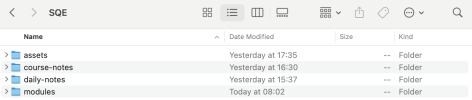
    I explained what I was trying to do to Codex, who set up a simple folder structure:

    1777359817481.png

    • Assets: This is where I store image files. This is just personal to me as I want to log things that weren't obvious to me when I started. And it helps to have a place to pull screenshots.
    • Course Notes: This is where I store notes about how to study and what to expect from the SQE etc.
    • Daily Notes: These are my daily notes. I just send these to Codex to organise.
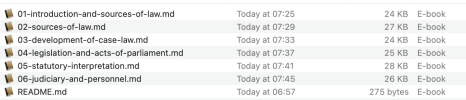
    • Modules: This is where I store revision notes. I'm not writing these myself, but I'm getting Codex to store a nice set of organised notes based on the revision books which I'll later use to test myself. These are stored as markdown files, just because it's easy to read for AI. Here's an example below.
    1777360037956.png
     
    • ℹ️
    Reactions: Alison C
    I used BARBRI too. It's a bit alarming not taking notes at all, but it really does help. You don't want loads of STUFF as you won't have time to re-digest and you need to internalise. Plus, the course goes back and you have time to go through everything again, at which point you CAN take notes/ keep records of questions you aren't getting correct, but your written material is more targeted. This helps avoid overwhelm.

    Like you, I did about three hours before work, sometimes a bit less so I could squeeze the gym in as well, in which case I would do a further hour at lunchtime. This is a test of endurance and psychological readiness, as you've noted, and you need to stay fit and healthy. I don't see diet and exercise featuring in your schedule and it's a non-negotiable. You need to avoid burnout and while front-loading the study is very wise, it's about balance. This is a one-shot attempt. The actual days of the test are gruelling and you need to be mentally and physically at peak.

    I did the BARBRI course over 40 weeks and spoke several times with the learning coach Stefano Palumbo who I liked. He encouraged a day off a week, which seems impossible, but is actually a really good idea. See if you can (1) access him and (2) schedule a day off (mine was Thursday, when I didn't do any SQE work but did my Italian class and homework - badly, but something completely different!).

    I also recorded myself reading the textbook chapters into my phone as voicenotes so I could re-listen on tube journeys, at the gym, etc etc. It's multi-sensory learning too (Oxford psychology grad/ Early Years teaching specialist here, advocating for a playful approach!) which is really good use of time and regarded as more effective.
     
    Last edited:
    • 🏆
    Reactions: Jaysen
    I used BARBRI too. It's a bit alarming not taking notes at all, but it really does help. You don't want loads of STUFF as you won't have time to re-digest and you need to internalise. Plus, the course goes back and you have time to go through everything again, at which point you CAN take notes/ keep records of questions you aren't getting correct, but your written material is more targeted. This helps avoid overwhelm.

    Like you, I did about three hours before work, sometimes a bit less so I could squeeze the gym in as well, in which case I would do a further hour at lunchtime. This is a test of endurance and psychological readiness, as you've noted, and you need to stay fit and healthy. I don't see diet and exercise featuring in your schedule and it's a non-negotiable. You need to avoid burnout and while front-loading the study is very wise, it's about balance. This is a one-shot attempt. The actual days of the test are gruelling and you need to be mentally and physically at peak.

    I did the BARBRI course over 40 weeks and spoke several times with the learning coach Stefano Palumbo who I liked. He encouraged a day off a week, which seems impossible, but is actually a really good idea. See if you can (1) access him and (2) schedule a day off (mine was Thursday, when I didn't do any SQE work but did my Italian class and homework - badly, but something completely different!).

    I also recorded myself reading the textbook chapters into my phone as voicenotes so I could re-listen on tube journeys, at the gym, etc etc. It's multi-sensory learning too (Oxford psychology grad/ Early Years teaching specialist here, advocating for a playful approach!) which is really good use of time and regarded as more effective.
    This is very helpful. Thank you Alison!

    How good did you find the Barbri textbooks compared to what comes up in the exam? Does it cover everything, or did you find anything was missing?

    (I'm just deciding whether it's enough for me to rely on solely and get a high score.)
     
    • 🤝
    Reactions: Alison C
    This is very helpful. Thank you Alison!

    How good did you find the Barbri textbooks compared to what comes up in the exam? Does it cover everything, or did you find anything was missing?

    (I'm just deciding whether it's enough for me to rely on solely and get a high score.)
    Honestly, I don't think any of the text books cover everything. There is too much. I had access to the U Law books and used them selectively but it's much more about exam technique than retaining information in a linear way. I did feel there were a LOT of questions that I flagged during my exams, particularly FLK2 in the morning (which I gather a lot of people hated - I was in the July 2025 sitting where only 41% passed). So there was a lot that I felt I had to guess. But that's sort of the nature of the beast, to get comfortable with being uncomfortable.

    The most helpful materials, when you have a grasp of the subject matter, are questions from different providers. That's because the language, fact patterns and interaction between subject matter varies. I used all the BARBRI tests at least once, many of them multiple times. I used their tracking system to see where my weaknesses were. I used the hard copy Revise SQE tests but not soon enough in my journey - these really helped look for different question styles and some different fact patterns and answers. However, in my actual exam I also remember there being a number of questions mixing subject areas that I just had to hold my nose and decide on. That's where having seen different styles of question-setting is really useful. And in the end, unfortunately, a lot of the SQE feels like a nuanced English test!

    I heard that the One Hundred provide good tests. I didn't know about them in time (and was already quite stretched financially). BARBRI is good enough to pass and many people do get a high score. But, annoying though it seems, it's better to focus on the general approach than expecting yourself to come in the first quintile. If I did it again, I'd use the Revise SQE tests at the same time as the BARBRI mocks, and then I'd pay for the One Hundred maybe 2/3 into my journey. And I'd be super strict about not looking up answers immediately. You need to get used to moving on through, not knowing if you got an answer correct (unlike the main BARBRI practices which immediately tell you the reasoning).

    I also found the BARBRI workshops to be helpful though not everyone agreed with that. They taught me how to think about the questions. Therefore, don't look at the SRA papers as that's what they use for the workshops.

    It's worth having some tables (the BARBRI text book has some good ones) on, eg, CPR timeframes, different types of offences etc. That's the rote learning you need to have. And don't think that a fact is too small - I think I had at least two questions on how to address a judge/magistrate etc, an easy win, and I don't remember feeling confident I got it right.

    You will get into the swing! And you want to avoid having too much written down as there is just that - too much.

    Looking forward to updates!
     
    Last edited:
    • Like
    Reactions: Jaysen
    Honestly, I don't think any of the text books cover everything. There is too much. I had access to the U Law books and used them selectively but it's much more about exam technique than retaining information in a linear way. I did feel there were a LOT of questions that I flagged during my exams, particularly FLK2 in the morning (which I gather a lot of people hated - I was in the July 2025 sitting where only 41% passed). So there was a lot that I felt I had to guess. But that's sort of the nature of the beast, to get comfortable with being uncomfortable.

    The most helpful materials, when you have a grasp of the subject matter, are questions from different providers. That's because the language, fact patterns and interaction between subject matter varies. I used all the BARBRI tests at least once, many of them multiple times. I used their tracking system to see where my weaknesses were. I used the hard copy Revise SQE tests but not soon enough in my journey - these really helped look for different question styles and some different fact patterns and answers. However, in my actual exam I also remember there being a number of questions mixing subject areas that I just had to hold my nose and decide on. That's where having seen different styles of question-setting is really useful. And in the end, unfortunately, a lot of the SQE feels like a nuanced English test!

    I heard that the One Hundred provide good tests. I didn't know about them in time (and was already quite stretched financially). BARBRI is good enough to pass and many people do get a high score. But, annoying though it seems, it's better to focus on the general approach than expecting yourself to come in the first quintile. If I did it again, I'd use the Revise SQE tests at the same time as the BARBRI mocks, and then I'd pay for the One Hundred maybe 2/3 into my journey. And I'd be super strict about not looking up answers immediately. You need to get used to moving on through, not knowing if you got an answer correct (unlike the main BARBRI practices which immediately tell you the reasoning).

    I also found the BARBRI workshops to be helpful though not everyone agreed with that. They taught me how to think about the questions. Therefore, don't look at the SRA papers as that's what they use for the workshops.

    It's worth having some tables (the BARBRI text book has some good ones) on, eg, CPR timeframes, different types of offences etc. That's the rote learning you need to have. And don't think that a fact is too small - I think I had at least two questions on how to address a judge/magistrate etc, an easy win, and I don't remember feeling confident I got it right.

    You will get into the swing! And you want to avoid having too much written down as there is just that - too much.

    Looking forward to updates!

    Ok this is great. I'll get Revise SQE and One Hundred. Thank you for this!
     
    • Love
    Reactions: Alison C
    Overall:
    - you are trying to pass, not to excel (excellence may come later)
    - you need to have a balanced approach, which includes time off, and learning when your peak times are
    - you won't know everything - but you will learn from your errors and from different question types, and you will become more precise
    - you don't need notes yet, you need to understand and retain, and revisit and make notes later
    - follow the BARBRi guidelines as much as you can, and then later introduce additional materials, around the time of the first full mock
    - find what works for you, and then change it up every so often
    - build in contingency time - eg for those unexpected emergencies

    So much support is flowing your way, it's great you are undertaking this challenge now!
     

    About Us

    The Corporate Law Academy (TCLA) was founded in 2018 because we wanted to improve the legal journey. We wanted more transparency and better training. We wanted to form a community of aspiring lawyers who care about becoming the best version of themselves.

    Get Our 2026 Vacation Scheme Guide

    Nail your vacation scheme applications this year with our latest guide, with sample answers to law firm questions.