

Hey all - a kind person (Denisa) shared these notes with me.
And they said it was okay for me to share it here too:
Tricks for Memory and Motivation that Worked for Me


Resources I Used
What I Wish I Knew Before Starting Revision
General Tips
And they said it was okay for me to share it here too:
Tricks for Memory and Motivation that Worked for Me
- Asking ChatGPT to test me on topics I particularly struggled with
- e.g., gave ChatGPT the Means Test thresholds for the Crown Court and the Magistrates Test first (otherwise it will get them wrong), and then I asked it to test me multiple times on the thresholds until I got them right
- Set myself a daily reading target to ensure I am on track for finishing all of the revision books
- E.g The contract revision book has 10 chapters with roughly 20 pages each. By reading 5 pages a day (better than reading nothing on days when motivation is nonexistent), I knew I would be done with contract law revision in 40 days.
- After I am done learning/revising a topic, I would test myself with a few MCQs to ensure I have understood it and revisit the parts I got wrong
- Using visual aids and handwritten summaries:
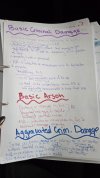
- In addition to having digital notes, I also wrote out summaries for each topic by hand (handwriting can be good for memory). I put the summarised notes in a folder and separated them by FLK1 and FLK2 sections and further sub-sections with index tabs for each law topic.
- During the exam breaks, I found it easier to check my physical notes through the folder than to look over my digital notes because I could quickly flick through the pages and see what stood out, as I had also made diagrams and colour-coded most of the notes. E.g
- Using a Pomodoro timer to ensure I log in enough study hours and remain focused
- Doing as many practice papers as I could get access to, at first without timing myself and then timing myself to ensure I do not run out of time in the exam
- Listening to lo-fi music to help me focus while I study
- A reward system ( can you tell these tips are from someone with ADHD?)
- e.g., 3 hours of study = 1 episode of my favourite show, snack and a latte
- Annotating the revision books (this is why I like physical books in addition to digital ones), even just underlining important parts with a pencil, proved helpful.
- I also asked my friends and family to ask me SQE questions out of the blue
Resources I Used
- Digital e-books from BPP;
- The BPP Century platform, which tracks your progress and uses AI to identify which topic you underperform in and gives you multiple MCQs to test yourself.
- The full Revise SQE collection of revision books and practice assessments
- SRA’s published practice papers
- BPP practice papers
- Preptackle, especially their “cheat sheets”
- The FLK1 and FLK2 spec: https://sqe.sra.org.uk/assessments/sqe1-assessments/sqe1-specification/flk https://sqe.sra.org.uk/assessments/sqe1-assessments/sqe1-specification/flk2
- The SRA’s exam functionality demo to familiarise myself with the software used for the exam: https://abe-prd-1.pearsonvue.com/st...sionUUID=676a2b01-0384-41fa-bf8d-7b557161d52b
- Quizlet flashcards
- The SQE2 spec may also be useful to check in addition to the SQE1 spec even if certain topics are not examined. Here is why:
- It is easier to read than the SQE1 spec
- Fewer topics are examinable, but you can easily see what stands out and considered most important to know. It is a bit backwards but once you have been though the whole course it makes sense. It is essentially reverse engineering the SQE and looking at the SQE2 spec as a priority map. If something is on the SQE2 spec and it is a dominant topic in SQE1.
- SQE Revise checklist (I found it useful to create an Excel version of this for easier tracking). They have one for each topic:
What I Wish I Knew Before Starting Revision
General Tips
- Pay attention to terms such as ‘may, must, and, or’
- Ensure you know the limbs of any relevant legal test
- You do not need to remember the names of case law or statutory provisions unless specified by the spec
- Make sure you track legal changes. I remember the tax thresholds and the maximum sentence a Magistrate Court could impose changed before my exam so some parts of my revision books were no longer up to date.
- The majority of contract law MCQs focus on the elements of contract creation (offer, acceptance, consideration, intention to create legal relations, certainty, and capacity)
- Some MCQs are very easy and may ask if acceptance has taken place in a given scenario, while others may be more complex and focus on whether a contract with a minor can be enforced.
- What I found tricky was remembering when a contract is void and when it is voidable, and the situations in which it can be rescinded or if only damages can be recovered
- Discharge of contracts - the challenging part, in my opinion, is what can be recovered for partial performance and frustration, depending on when the expenses were incurred.
- Implied terms - Consumer Rights Act, Sales of Goods Act, and the Supply of Goods and Services Act
- Some MCQs will focus entirely on double-entry bookkeeping and identifying the relevant pairs of accounting entries for business accounts and client accounts
- A smaller percentage of MCQs focus on solicitor accounts compared to other topics, but identifying correct account entries can be the chance to gain easy marks
- To me, this is the subject where the most memorisation is required, followed by Criminal Practice. Because the CPR sets out the rules of litigation, the hardest part is memorising the different timescales and timelines of proceedings, so this is one of the topics where logic and common sense can be relied on the least to save you if the MCQ tests you on an unknown question.
- I focused particularly on the rules around counting time, the different court tracks, where a claim should be commenced, and interim applications (this is not a full list, but this is what stood out the most and what I struggled with; the rules around evidence and privilege are also important to remember, but I do not think they are as challenging)
- The rules around default judgment, summary judgment, and strike-off
- The cost procedure is particularly technical as well as calculating the claim value
- The hearsay rules may be challenging, but what I found more challenging is remembering how the definitions differ between Dispute Resolution and Criminal Practice.
- A lot of MCQs on settlement will focus on the effect of the parties if the settlement is rejected or accepted, e.g., will a penalty apply if the settlement is rejected?
- The most challenging parts to me were:
- The rules around EU law after Brexit
- The devolved institutions
- How to deduce and investigate the title depending on whether the title is registered or unregistered. Unregistered titles are more challenging.
- What takes place at pre-completion, completion and post-completion
- The structure and contents of a lease
- You have to familiarise yourself with the Standards Conditions of Sale and the Commercial Standard Conditions of Sale. This needs to be memorised.
- Property taxation and termination of leases were also very challenging
- The definitions of equitable and legal interests.
- Covenants, easements and remembering how they are identified, some MCQs may ask what a Class D (ii) charge is
- Passing of the burden vs taking the benefit of a covenant (good luck!!)
- One of the easiest topics, just remember it will come up in both FLK1 and FLK2
- What may be challenging is the rule against self-dealing and the Etridge guidelines
- You need to know the SRA Principles and the Code of Conduct for Solicitors and the Code of Conduct for Firms.
- The focus of the MCQs will be on the different elements of the offence; you need to be able to differentiate the actus reus and the mens rea of different offences. E.g has a s. 47 OAPA 1861 has been committed? Yes, because there is no requirement to foresee injury.
- The offences the exam will cover are: inchoate offences, homicide offences, offences against the person, theft, criminal damage, and fraud. Make sure you know the elements for each one.
- What I found challenging is:
- when specific intent or basic intent is required for the offence to be committed
- The definition of ulterior intent
- Voluntary and involuntary intoxication, and how it applies to the validity of the defence
- Advising clients
- Should they give a no-comment interview, answer questions or give a written statement?
- Funding - the means and merit test in the Magistrate’s Court and the Crown Court.
- Bail applications and the different factors when considering bail
- Introducing bad character evidence and the gateways under which it can be done, memorise the gateways.
- Remember which offences are imprisonable, non-imprisonable, as well as indictable only, summary only and either way, as this will impact your advice to the client and the procedure that will apply to the case.
- The whole trial process, from start to finish, and case management questions were particularly challenging
- Evidence - hearsay rules, the Turnbull Guidelines are very important to remember. As well as excluding evidence under ss.76 and ss.78 of PACE 1984 (you need to memorise the statutory provisions). You also need to know inferences from silence ss.34 - ss. 38 of CJPOA 1994.
- Appeals and sentencing rules can be particularly technical. Familiarise yourself with the sentencing guidelines and the reduction of sentence depending on when the client pleads guilty.
- The Youth Court - the sentences and orders available, the age thresholds and joint-enterprise offences which may mean a youth may be tried alongside an adult (this is very technical). Grave crime definitions may also come up as an MCQ.
- Taxation and relief rules
- Calculating income tax, capital gains tax, corporation tax, and inheritance tax
- Annual investment allowance, trading loss relief etc,
- Clawback of assets in the event of bankruptcy/ insolvency
- The difference between bankruptcy and insolvency
- Voting rights and declaring interest
- Shareholders vs director duties and rights
- You have to know the contents of the Model Articles
- Removal of a director - the different timelines depending on a cooperative or a non-cooperative board of directors
- The different types of business and how to set up a business, change the name or change the office.
- The rules around substantial property transactions
- The standard order of priority in liquidation - I would memorise it
- The rules around the buy-back of shares
- Funding, types of security, accounting requirements and distribution of profits.
- Money laundering - Proceeds of Crime Act 2002 and FSMA 2000 are particularly technical; in my experience, there is always an MCQ on this topic.
- Negligence almost always comes up
- Defences (but this is not very challenging)
- Occupier’s Liability, as well as the Consumer Protection Act also tend to come up
- Nuisance - you have to know the rule in Rylends v Fletcher
- Public and private nuisance - this is somewhat technical, and the MCQs focus on who has standing to pursue a claim and also on the available remedies
- Validity of wills - you need to know if the formalities have been met. Effectively, you need to be able to draft a valid will.
- Personal representatives - appointment of executors/personal representatives and the order for which a person can be appointed (similar to the order of intestacy)
- Alterations and revocations of a will - what the MCQs focus on is whether the change/ revocation was effective
- The intestacy rules - this is where you need to memorise
- Which property fails outside of the estate
- IPFDA 1975 - this is where you need to know what factors the court may take into account to determine if a family member can claim financial compensation from the estate of a deceased person. The tests are very subjective, and the challenge here is that the results from IPFDA are somewhat unpredictable because of the wide discretion the court has.
- Calculating inheritance tax - the tip here is to write out the steps in calculation and follow them until you know them by heart. Calculating lifetime transfers and immediately chargeable transfers is what I found challenging. You need to memorise the applicable reliefs available to the estate.
- You should be able to calculate any income tax and capital gains tax applicable to the administrator of the estate
- You need to know the powers and duties of the personal representatives
- The types of trusts
- The creation and requirements of express trusts, inter vivos trusts. The rules here are very technical, in my opinion
- Beneficial entitlement - the rule in Saunders v Vautier. Also, you need to know if an interest is contingent, vested, fixed or discretionary, as it will affect the beneficiary’s ability to receive the trust assets.
- Resulting trusts (this, to me, is where you can gain easy marks)
- The distinction between charitable and non-charitable purpose trusts - this is where it gets technical again
- Trusts to the family home (this you might remember from law school)
- The powers and duties of trustees
- Liability of trustees
- The rules around tracing and following
- Court structure - you might remember this from law school. MCQs focus on determining which matters get heard where and addressing a judge correctly.
- Funding options for legal services - this tests funding for criminal and civil matters.
- Regulation of legal services - you need to know what falls within and outside the scope of ‘reserved legal activity’. You also need to familiarise yourself with other regulators other than the SRA, such as CILEx and IPREG.
- MCQs may focus on whether the professional indemnity insurance a firm has is sufficient to meet the SRA’s requirements
- Sources of law: primary legislation, statutory interpretation and case law. MCQs particularly focus on the golden rule, literal rule, mischief rule and purposive approach


