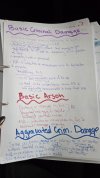
I bimbofied my SQE1 notes and honestly it's the only way I'm retaining anything

I'm currently studying for the January 2027 sitting (currently using 25/26 Revise SQE/ULaw textbooks).

When I started earlier this year, I was hitting a wall with the standard materials. Everything was just too dense to retain, and I knew that fundamentally understanding the basic legal principle would serve me better in the long run than rote learning pages and pages of dry legal textbooks.

Which is why I 'bimbofied' my notes - ABSOLUTE GAMECHANGER and this is a tip that I recommend to everyone.

When you break down the legalese and insert pop culture references, active recall comes so much easier. Remember, the more ludicrous, the better.

Sharing a few pages from my Contract notes in case anyone else is struggling with the same thing. I've done all of FLK1 and FLK2 .

Attachments

  • Screenshot 2026-06-25 at 20.09.28.png
    Screenshot 2026-06-25 at 20.09.28.png
    1.3 MB · Views: 11
  • Screenshot 2026-06-25 at 20.10.08.png
    Screenshot 2026-06-25 at 20.10.08.png
    931.1 KB · Views: 11
  • Screenshot 2026-06-25 at 20.10.18.png
    Screenshot 2026-06-25 at 20.10.18.png
    1 MB · Views: 11

SQE Advice - What I Wish I'd Known Before SQE1 & 2

TCLA helped me a lot when I was applying for vacation schemes and training contracts, so I thought I'd pay it forward and share some advice on the SQE.

About Me

  • 21-year-old future trainee at an international law firm.
  • Graduated with an LLB in 2024 and an LLM in 2025.
  • Studied full-time on BPP's LLM Legal Practice (SQE1 & SQE2) course from September 2025 onwards, sponsored by my firm.
  • Sat SQE1 in January 2026 and passed in the first quintile.
  • Sat SQE2 in April/May 2026 and am currently waiting for results (fingers crossed!).
Like many people sitting these exams, I often felt overwhelmed by the sheer volume of content and spent far too much time worrying whether I was doing enough.

What I Wish I'd Known Before SQE1

1. You do not need to know everything

At some point, you have to accept that nobody walks into SQE1 knowing everything. The goal isn't perfection. It's knowing enough law to consistently identify the best answer.

2. Question practice is SO important

Looking back, I would have started question practice much earlier, instead of waiting till 'I was ready or knew everything'.

I used the following question banks:

  • OUP
  • Revise SQE
  • QLTS
  • The 100
  • ULaw question bank
The more questions you do, the more familiar the exam starts to feel, and you will start identifying patterns.

3. Getting questions wrong is part of the process

Some of my biggest improvements came from reviewing questions I'd answered wrong.

Don't panic if your scores aren't where you want them to be at the start. You are likely to score quite low in more difficult mocks such as QLTS and the100. Bad scores tell you where to focus your revision.

4. Don't neglect your weaker subjects

It's very easy to keep revising the subjects you enjoy because they make you feel productive. The biggest gains usually come from tackling the subjects you hate. For me, I dreaded constitutional law revision and scored quite low on it in the exam

5. Don't compare yourself to everyone else

There comes a point where another ten hours of revision won't magically transform your result. Trust the work you've already put in and don’t compare yourself to the amount of work others are doing. This will stress you out.

What I Wish I'd Known Before SQE2

1. Structure solves most problems

Start by laying out an email start and end, then structure the body around the actual issues identified in the task.
Even when you don't know the law perfectly, structure helps keep you stay organised and give you marks under the skills criteria.

2. You will probably never feel fully prepared

SQE2 felt much more open-ended, and because of that I never really felt "ready" and could not necessarily track my progress with scores. I walked into several assessments feeling underprepared and later realised that was completely normal.

3. Don't wait until you've revised everything before attempting mocks

This is probably the biggest mistake I nearly made. I kept feeling like I needed to cover more content before attempting full mocks. In reality, I learned far more from doing mocks than I expected. Especially practicing under times conditions.

Most of my mock practice came from BPP workshops and inhouseW mocks.

4. Don't obsess over individual assessments afterwards

At least one assessment will probably leave you convinced you've failed (speaking from experience!) That's normal. The exams are cumulative and one bad station is very unlikely to ruin your overall result.

If I Could Give One Piece of Advice

Everyone feels overwhelmed. Everyone thinks everyone else is doing more revision than they are. Everyone has moments where they think they're going to fail. Focus on your own preparation, trust the work you've put in, and try not to compare your journey to anybody else's.

SQE1: What to memorise for each subject

Hey all - a kind person (Denisa) shared these notes with me.

And they said it was okay for me to share it here too:

Tricks for Memory and Motivation that Worked for Me
  • Asking ChatGPT to test me on topics I particularly struggled with
    • e.g., gave ChatGPT the Means Test thresholds for the Crown Court and the Magistrates Test first (otherwise it will get them wrong), and then I asked it to test me multiple times on the thresholds until I got them right
  • Set myself a daily reading target to ensure I am on track for finishing all of the revision books
    • E.g The contract revision book has 10 chapters with roughly 20 pages each. By reading 5 pages a day (better than reading nothing on days when motivation is nonexistent), I knew I would be done with contract law revision in 40 days.
  • After I am done learning/revising a topic, I would test myself with a few MCQs to ensure I have understood it and revisit the parts I got wrong
  • Using visual aids and handwritten summaries:
    • In addition to having digital notes, I also wrote out summaries for each topic by hand (handwriting can be good for memory). I put the summarised notes in a folder and separated them by FLK1 and FLK2 sections and further sub-sections with index tabs for each law topic.
    • During the exam breaks, I found it easier to check my physical notes through the folder than to look over my digital notes because I could quickly flick through the pages and see what stood out, as I had also made diagrams and colour-coded most of the notes. E.g
  • Using a Pomodoro timer to ensure I log in enough study hours and remain focused
  • Doing as many practice papers as I could get access to, at first without timing myself and then timing myself to ensure I do not run out of time in the exam
  • Listening to lo-fi music to help me focus while I study
  • A reward system ( can you tell these tips are from someone with ADHD?)
    • e.g., 3 hours of study = 1 episode of my favourite show, snack and a latte
  • Annotating the revision books (this is why I like physical books in addition to digital ones), even just underlining important parts with a pencil, proved helpful.
  • I also asked my friends and family to ask me SQE questions out of the blue

1778957960518.jpeg1778957960512.jpeg1778957960505.jpeg


Resources I Used
  • Digital e-books from BPP;
  • The BPP Century platform, which tracks your progress and uses AI to identify which topic you underperform in and gives you multiple MCQs to test yourself.
  • The full Revise SQE collection of revision books and practice assessments
  • SRA’s published practice papers
  • BPP practice papers
  • Preptackle, especially their “cheat sheets”
  • The FLK1 and FLK2 spec: https://sqe.sra.org.uk/assessments/sqe1-assessments/sqe1-specification/flk https://sqe.sra.org.uk/assessments/sqe1-assessments/sqe1-specification/flk2
  • The SRA’s exam functionality demo to familiarise myself with the software used for the exam: https://abe-prd-1.pearsonvue.com/st...sionUUID=676a2b01-0384-41fa-bf8d-7b557161d52b
  • Quizlet flashcards
  • The SQE2 spec may also be useful to check in addition to the SQE1 spec even if certain topics are not examined. Here is why:
    • It is easier to read than the SQE1 spec
    • Fewer topics are examinable, but you can easily see what stands out and considered most important to know. It is a bit backwards but once you have been though the whole course it makes sense. It is essentially reverse engineering the SQE and looking at the SQE2 spec as a priority map. If something is on the SQE2 spec and it is a dominant topic in SQE1.
  • SQE Revise checklist (I found it useful to create an Excel version of this for easier tracking). They have one for each topic:
1778957960527.png


What I Wish I Knew Before Starting Revision

General Tips
  • Pay attention to terms such as ‘may, must, and, or’
  • Ensure you know the limbs of any relevant legal test
  • You do not need to remember the names of case law or statutory provisions unless specified by the spec
  • Make sure you track legal changes. I remember the tax thresholds and the maximum sentence a Magistrate Court could impose changed before my exam so some parts of my revision books were no longer up to date.
Contract Law
  • The majority of contract law MCQs focus on the elements of contract creation (offer, acceptance, consideration, intention to create legal relations, certainty, and capacity)
  • Some MCQs are very easy and may ask if acceptance has taken place in a given scenario, while others may be more complex and focus on whether a contract with a minor can be enforced.
  • What I found tricky was remembering when a contract is void and when it is voidable, and the situations in which it can be rescinded or if only damages can be recovered
  • Discharge of contracts - the challenging part, in my opinion, is what can be recovered for partial performance and frustration, depending on when the expenses were incurred.
  • Implied terms - Consumer Rights Act, Sales of Goods Act, and the Supply of Goods and Services Act
Solicitor’s Accounts
  • Some MCQs will focus entirely on double-entry bookkeeping and identifying the relevant pairs of accounting entries for business accounts and client accounts
  • A smaller percentage of MCQs focus on solicitor accounts compared to other topics, but identifying correct account entries can be the chance to gain easy marks
Dispute Resolution
  • To me, this is the subject where the most memorisation is required, followed by Criminal Practice. Because the CPR sets out the rules of litigation, the hardest part is memorising the different timescales and timelines of proceedings, so this is one of the topics where logic and common sense can be relied on the least to save you if the MCQ tests you on an unknown question.
  • I focused particularly on the rules around counting time, the different court tracks, where a claim should be commenced, and interim applications (this is not a full list, but this is what stood out the most and what I struggled with; the rules around evidence and privilege are also important to remember, but I do not think they are as challenging)
  • The rules around default judgment, summary judgment, and strike-off
  • The cost procedure is particularly technical as well as calculating the claim value
  • The hearsay rules may be challenging, but what I found more challenging is remembering how the definitions differ between Dispute Resolution and Criminal Practice.
  • A lot of MCQs on settlement will focus on the effect of the parties if the settlement is rejected or accepted, e.g., will a penalty apply if the settlement is rejected?
Constitutional Law
  • The most challenging parts to me were:
    • The rules around EU law after Brexit
    • The devolved institutions
Property Practice
  • How to deduce and investigate the title depending on whether the title is registered or unregistered. Unregistered titles are more challenging.
  • What takes place at pre-completion, completion and post-completion
  • The structure and contents of a lease
  • You have to familiarise yourself with the Standards Conditions of Sale and the Commercial Standard Conditions of Sale. This needs to be memorised.
  • Property taxation and termination of leases were also very challenging
Land Law
  • The definitions of equitable and legal interests.
  • Covenants, easements and remembering how they are identified, some MCQs may ask what a Class D (ii) charge is
  • Passing of the burden vs taking the benefit of a covenant (good luck!!)
Ethics and Professional Conduct
  • One of the easiest topics, just remember it will come up in both FLK1 and FLK2
  • What may be challenging is the rule against self-dealing and the Etridge guidelines
  • You need to know the SRA Principles and the Code of Conduct for Solicitors and the Code of Conduct for Firms.
Criminal Law
  • The focus of the MCQs will be on the different elements of the offence; you need to be able to differentiate the actus reus and the mens rea of different offences. E.g has a s. 47 OAPA 1861 has been committed? Yes, because there is no requirement to foresee injury.
    • The offences the exam will cover are: inchoate offences, homicide offences, offences against the person, theft, criminal damage, and fraud. Make sure you know the elements for each one.
  • What I found challenging is:
    • when specific intent or basic intent is required for the offence to be committed
    • The definition of ulterior intent
    • Voluntary and involuntary intoxication, and how it applies to the validity of the defence
Criminal Practice
  • Advising clients
    • Should they give a no-comment interview, answer questions or give a written statement?
  • Funding - the means and merit test in the Magistrate’s Court and the Crown Court.
  • Bail applications and the different factors when considering bail
  • Introducing bad character evidence and the gateways under which it can be done, memorise the gateways.
  • Remember which offences are imprisonable, non-imprisonable, as well as indictable only, summary only and either way, as this will impact your advice to the client and the procedure that will apply to the case.
  • The whole trial process, from start to finish, and case management questions were particularly challenging
  • Evidence - hearsay rules, the Turnbull Guidelines are very important to remember. As well as excluding evidence under ss.76 and ss.78 of PACE 1984 (you need to memorise the statutory provisions). You also need to know inferences from silence ss.34 - ss. 38 of CJPOA 1994.
  • Appeals and sentencing rules can be particularly technical. Familiarise yourself with the sentencing guidelines and the reduction of sentence depending on when the client pleads guilty.
  • The Youth Court - the sentences and orders available, the age thresholds and joint-enterprise offences which may mean a youth may be tried alongside an adult (this is very technical). Grave crime definitions may also come up as an MCQ.
Business Law and Practice
  • Taxation and relief rules
    • Calculating income tax, capital gains tax, corporation tax, and inheritance tax
    • Annual investment allowance, trading loss relief etc,
  • Clawback of assets in the event of bankruptcy/ insolvency
  • The difference between bankruptcy and insolvency
  • Voting rights and declaring interest
  • Shareholders vs director duties and rights
  • You have to know the contents of the Model Articles
  • Removal of a director - the different timelines depending on a cooperative or a non-cooperative board of directors
  • The different types of business and how to set up a business, change the name or change the office.
  • The rules around substantial property transactions
  • The standard order of priority in liquidation - I would memorise it
  • The rules around the buy-back of shares
  • Funding, types of security, accounting requirements and distribution of profits.
  • Money laundering - Proceeds of Crime Act 2002 and FSMA 2000 are particularly technical; in my experience, there is always an MCQ on this topic.
Tort Law
  • Negligence almost always comes up
  • Defences (but this is not very challenging)
  • Occupier’s Liability, as well as the Consumer Protection Act also tend to come up
  • Nuisance - you have to know the rule in Rylends v Fletcher
  • Public and private nuisance - this is somewhat technical, and the MCQs focus on who has standing to pursue a claim and also on the available remedies
Wills and the Administration of Estates
  • Validity of wills - you need to know if the formalities have been met. Effectively, you need to be able to draft a valid will.
  • Personal representatives - appointment of executors/personal representatives and the order for which a person can be appointed (similar to the order of intestacy)
  • Alterations and revocations of a will - what the MCQs focus on is whether the change/ revocation was effective
  • The intestacy rules - this is where you need to memorise
  • Which property fails outside of the estate
  • IPFDA 1975 - this is where you need to know what factors the court may take into account to determine if a family member can claim financial compensation from the estate of a deceased person. The tests are very subjective, and the challenge here is that the results from IPFDA are somewhat unpredictable because of the wide discretion the court has.
  • Calculating inheritance tax - the tip here is to write out the steps in calculation and follow them until you know them by heart. Calculating lifetime transfers and immediately chargeable transfers is what I found challenging. You need to memorise the applicable reliefs available to the estate.
  • You should be able to calculate any income tax and capital gains tax applicable to the administrator of the estate
  • You need to know the powers and duties of the personal representatives
Trusts Law
  • The types of trusts
  • The creation and requirements of express trusts, inter vivos trusts. The rules here are very technical, in my opinion
  • Beneficial entitlement - the rule in Saunders v Vautier. Also, you need to know if an interest is contingent, vested, fixed or discretionary, as it will affect the beneficiary’s ability to receive the trust assets.
  • Resulting trusts (this, to me, is where you can gain easy marks)
  • The distinction between charitable and non-charitable purpose trusts - this is where it gets technical again
  • Trusts to the family home (this you might remember from law school)
  • The powers and duties of trustees
  • Liability of trustees
  • The rules around tracing and following
Legal System and Services of England and Wales
  • Court structure - you might remember this from law school. MCQs focus on determining which matters get heard where and addressing a judge correctly.
  • Funding options for legal services - this tests funding for criminal and civil matters.
  • Regulation of legal services - you need to know what falls within and outside the scope of ‘reserved legal activity’. You also need to familiarise yourself with other regulators other than the SRA, such as CILEx and IPREG.
  • MCQs may focus on whether the professional indemnity insurance a firm has is sufficient to meet the SRA’s requirements
  • Sources of law: primary legislation, statutory interpretation and case law. MCQs particularly focus on the golden rule, literal rule, mischief rule and purposive approach

SQE 26/27 Discussion Thread

Hey everyone!

Whether you're taking the exam in July or starting in September, this thread is for anyone who wants to prepare ahead of the SQE.

Feel free to introduce yourself here!

Relevant threads​

  1. SQE Journey/Tips by @WillKitchen
  2. SQE Tell All by @average_jo123
  3. Best SQE1 Resources by @plw
  4. Jaysen does the SQE

SQE Journeys / Tips (July 2026 Exam)

Thanks to @Jaysen for inviting me to share some of my experiences studying for the SQE.

I’ll share a bit of background, how I ended up on an SQE course, and then my best study tip. I hope this is interesting / useful, and I'd be happy to hear other's stories, too...

My Background

In 2024, I decided to retrain as a solicitor. It had been a long time coming. Back in 2009, when choosing my A Levels, my plan was to enter the law. But a very rewarding time at university studying creative industries encouraged me to consider an academic pathway. After receiving a Vice-Chancellor’s Scholarship from the University of Southampton in 2016, I completed a PhD and began teaching. Over the next 8 years or so, I wrote a number of books for Bloomsbury and Edinburgh University Press. I also did a bit of employment law policy and leadership research advisory work and secured my first NED role.

Unusually for an academic, I discovered that I enjoyed the more administrative side of the job: committees, examinations, policy review, governance, global team leadership. By the time COVID came along and destabilised the academic job market, I had established a strong professional profile (including leading an international research team of 20 people from the UK, Sweden, Japan, Canada and the USA) and developed many transferrable skills that could now perhaps be put to better use in commercial law. After finishing my fourth book, I undertook the career move that had been on my mind, on and off, since about 2009.

SQE 1 Prep Course

The first important choice was whether to complete a conversion course / LLM or go directly to SQE 1 Prep. I spoke with several Law academics, and they confirmed my choice to dive into the deep end with SQE prep. I already had three degrees and the necessary discipline to undertake self-directed study. After researching several options (balancing practicality with reputation), I signed-up for a 40-week part-time SQE 1 Prep course with BARBRI, for the July 2026 exam.

My decision to self-fund SQE 1 was strategic. A training contract is equally important, of course, but given the fact that I had limited commercial legal qualifications on my CV (just one week of work experience at a mid-sized regional firm, and a few other bits and pieces), I wanted to start SQE under my own steam so that law firms could see that I was committed to the new career. And, if it might take longer than planned to receive a TC offer, then I would be taking at least one practical step forward in 2026.

The BARBRI course included an Introduction to Law module. This established some of the key principles of legal study, giving me the confidence to catch up with fellow students who might have completed a Law degree or conversion course. BARBRI encourages students to manage their own “PSP” (Personal Study Plan), organising their revision around work and planning study days to suit their schedule. Nevertheless, it is very common for students to create independent study plans alongside the PSP, including flashcards and additional readings (such as the Revise SQE book series by Amy and David Sixsmith).

Preparing for SQE 1 is very different to writing a PhD thesis, and so I had to adopt a new kind of study plan. Although they are not for everyone, I found that flashcards were very effective tools. A typical study day for me involves completing a few hours on the PSP, reading a chapter or two of Revise SQE, and creating a handful of flashcards based on any information that is not quite going in. I regularly put a handful of cards in my pocket and go out for a walk in the countryside, reading and memorising information as I go.

Those activities account for about 90% of my study method. Flashcards are not to everyone’s taste, of course, but here is one tip that has worked well for me…

Study Tip

Try to come up with silly but memorable ways of retaining information. SQE 1 requires you to cram a large number of different dates, facts, figures and time periods. A lot of the data is very dry, and it is easy to get a little mixed up. When studying, I try to find a way of recontextualising that information by assigning it a cultural reference or narrative function.

For example, take the rule about survivorship: if a spouse or civil partner dies and their partner does not survive for 28 days, their partner does not inherit under their estate. If you can find a way to anchor that number in a scenario that is easy to recall – perhaps for the simple reason that it is a bit silly – that will greatly improve your chances of recalling that information during an MCQ.

I found that I could make the rule memorable by thinking about the zombie film 28 Days Later (2002). All I needed to do was create an association between the rule on survivorship and the word “zombie”. This is an effective method because a study flashcard that says “Survivorship, zombies” is far more memorable (I would hope!) than a flashcard saying “Survivorship, 28 days”. It’s about introducing an element of colour and uniqueness into the study process – giving a jolt of electricity to a rather dry procedural rule. Once the connection to survivorship has been formed, you’ll never forget that period of “28 days”, because its right there in the film’s title. The rule will be contained within that bizarre connection you have forced your brain to make.

This can be surprisingly effective, especially if you manage to align form and content, as in the example above. It might not be enough to give you the “single best answer” every time, but it will be a useful tool to guide your judgement when interpreting a question and the answer choices that are on offer.


Attachments

  • Screenshot.png
    Screenshot.png
    2 MB · Views: 28

Jaysen does the SQE

Okay, I never thought I'd be posting my own thread, but why not.

I'm taking SQE1 in July. You can read more about my reasons here.

I'll use this thread to write about the process.

What I'm hoping is I can share, in real time:
  • Advice I get about how to do well
  • Techniques I use to study
  • Things that aren't obvious
If anyone is also taking the SQE now or in the future, you are also very welcome to start your own thread in this forum.

SQE 2 Planning

Hi all,

I hope this is the right place to post. I'm looking for some advice about my options going forward. For context, I don't have a TC, I am sitting SQE 1 in the next two weeks, and need to decide whether to continue straight on to preparing for the SQE 2 exam, or to wait and begin SQE 2 preparation after I get my SQE 1 results in March.

I have no idea what the most common approach people take in this situation would be? I wonder if there is any correlation between going straight on to SQE 2 and success in passing that exam, since I know that retaining SQE 1 knowledge is an important aspect of it?

I would really appreciate any guidance you can provide on how I should make this decision, as I cannot see a clear best answer, especially for what would happen if I were to start preparation for SQE 2 and then discover that I had not passed SQE 1.

Thank you 👍

SQE Plus and SQE2

Hi all,

Looking for a bit of advice and also just want a chance to ramble/vent.

I sat and passed the SQE1 in July 2024 sitting. I was meant to sit my SQE2 this year, but had a massive breakdown and decided nope, not doing this. Took a year off, basically just worked and chilled and restored my mental health.

I am hoping to the SQE2 in October next year (basically the last date I can sit it according to my scholarship provider).

There are two issues at hand:
1. I have basically forgotten EVERYTHING. All the FLK1 & FLK2 has been squeezed out of my brain like water from a sponge. Possibly because of the breakdown and so shunned that knowledge from my entire being. Also makes you wonder the effectiveness of the exams cause like realistically, what is the purpose of memorising that much when no one is actually going to remember it in the long run?
2. I got lucky. When I passed the SQE1. Because let me tell you, my Business Law and Criminal Practice knowledge was horrid. And no, I'm not being harsh on myself, it simply was horrid. I think I studied one week for both subjects before deciding that I am going to chance it and not study for either of them, and that God will be on my side. He was, there were BARELY any questions for business and criminal, and the ones that were there, I am certain I got wrong. But my other subjects defo covered me and lifted me up. But honestly, divine intervention helped me passed. Relating back to the problem, now for the SQE2 - I need to essentially learn business and crim (because clearly I didn't do it the first time).

Now, as for the overall timeline of my life, I've started the SQE Plus part of my degree, and hoping to sit SQE2 in October 2026. Has anyone done the SQE Plus? I thrive on course work, and so I think I'll be fine, but just wanted to reach out and check with others who've done the course and can advice on how difficult it is? My main reason for asking is because the SQE Plus finishes around March/April 2026. And from there on, I need to get back on the SQE2 horse. Issue is, in my mind, from April to October, its not enough time for me (personally) to study for the SQ2 - given I need to learn business/crim, re-learn everything else and also learn how to deal with each exam style. The (undiagnosed, but we're changing that) ADHD in me also gets distracted like hell, so to a neuro-typical person yes that MIGHT be plenty of time, but for me like girl it's not enough. And for some reason this silly exam doesn't allow me to rely on my superpowers of procrastination and cramming everything in the last minute (like I did for o and a levels).

So - if you're still here, what should I do? Start studying for the SQE2 now? Like, start making notes for business law/crim, and alongside do course work so when that April mark comes, at least business/crim are done?

I dont know - help, anyone?

Sincerely,
Someone who is fed up and considering the CLC

ULaw March Intake — Timetable Sample & Revision Tips

Hi everyone!

I’m starting at the University of Law, this March intake for the LLM SQE1 & SQE2 (Full-Time) course and wanted to reach out for a bit of guidance.

If anyone has a sample timetable from a recent ULaw March intake, I’d love to get an idea of how the weekly schedule looks, it’ll really help me plan ahead!

I have a few months before starting, and I’d like to begin preparing gradually. I’ve seen a few people recommend focusing on Contract Law, Tort Law, Criminal Law, Land Law, Equity & Trusts, and Public Law, but I’d really appreciate suggestions for:
  • Any beginner-friendly or revision books (concise guides, summaries, or case books you found helpful)
  • How best to structure early self-study or revision before the course starts
  • Any tips or resources that made your first term easier (study techniques, note-taking, case summaries, etc.)
Thank you so much in advance!!! x Any insight would be amazing - I’d love to make the most of this time before March.

Recent low SQE 1 pass rates (2025)

There has been some discussion of the low pass rates with the SQE 1 summer exams in recent weeks. As low as 41%...


How are people feeling about this?

If you are preparing to sit SQE 1 in summer 2026, are you concerned?

SQE textbook advice

Hi all,

I am starting the SQE LLM in Feb 2026 at BPP on the CCP, and am beginning to work out what I need to do to prep (not starting prep yet obviously!!). If anyone has any experience, recommendations, or criticisms of the various textbook providers, please could you tell me below. I would like to purchase a set of textbooks, as I have heard the BPP ones aren't hugely strong. Thanks!

Badly written SQE questions

Is anyone else finding practice SQE questions that are badly written and omitting key information necessary in order to make a reasonable judgement, even in reputable legal education books?

There is supposed to be a level of ambiguity in the possible answers that is designed to test our problem-solving and legal reasoning skills, of course. But I have seen more than one question which - in the explanation of the correct answer provided - assumes an awareness of specific facts about a case (not legal knowledge) that are not provided by the question.

Here is an example:

"A party was organised which took place in the woods. Starting at 11pm, the party continued for 12 hours and thousands of people attended. DJs played loud music, and attendees parked cars along the roads to the woods. There were no toilets or litter bins in the woods."

"What is the court's approach likely to be when considering if the party organiser created a public nuisance?"

The correct answer is: "The court is likely to find that the organiser created a public nuisance on the basis that noise and inconvenience affected the locals."

All the other answers are wrong, and not all of them assume that a claim has been brought by a particular person or class of people.

The problem is that the scenario contains no mention of any "locals", let alone their proximity to the party, attitude toward the event, or position in respect to a possible claim. So, when considering the question the reader immediately excludes this (correct) answer because it refers to specific information which is not taken for granted in the premise of the question. Public nuisance claims may be brought by individuals, classes or the Attorney General, but none of these possibilities are contextualised by the MCQ in a way which leads to the correct answer.

Has anyone else seen this kind of mistake in SQE question construction?

Tobacco Docks vs. Southwark - Which is Better for SQE1?

Hi

If someone on the forum has experience with these two SQE1 centres in London, could you please share your experience? Here is what I have gathered so far-

- Tobacco Docks - dedicated to SQE only (so no candidates taking other exams like accountancy, etc), large SQE1 centre, highly recommended but lots of candidates
- Southwark - smaller and more peaceful, but probably has mixed Pearson Vue candidates (not just SQE), so can be distracting

The candidate has mild depression/anxiety and will ask for reasonable adjustments if that helps.

Any other centre experience is also welcome

Thanks in advance.

International students studying/ have completed the SQE

I have a law degree from the UK and was able to secure a paralegal role at a high street firm whilst on my graduate visa. My visa, however, is due to expire in a few months and my current firm cannot sponsor me nor have I been able to find another role. So I am trying to weigh my options here, one of which is to self fund the SQE as a form of 'upskilling' and being more desirable to employers. Any advice?

Also, to those international students that have done or are in the process of taking the full-time SQE courses within the UK. How long was your student visa granted for and what is the duration of your course?

And to those international students that have completed it. Did you find it made it easier for you to land a legal role as an international?

Thanks :)
  • Like
Reactions: m.legalcontact

PLS HELP - SQE & Visa

Hi all, just for a bit of context I’m Swiss and was, until about a week ago, on a student visa in the UK. I deferred an exam which means I can’t get the graduate visa, but I wanted to ask a question regarding sitting 2 short SQE courses next year.

SQE 1 with my provider starts in Sep and teaching ends in December, and SQE 2 is from Feb 2nd until early March. However, the course also included the several revision weeks and holidays, which take up around 4-5 weeks. In summary, however, I calculated it by planning out when I would fly in and out, and I would only be in the UK for 5.5 months in total.

I just wanted to ask if anyone has experience with this.

Full time SQE - is there a Christmas break ?

Hi

Can anyone who has studied SQE full time or knows about it, help out? I am starting my sponsored full time SQE with BPP in September and as an international student, would like to travel to my home country in December to both rejuvenate as well as prepare for SQE1. Is there a formal break from studies for atleast a couple weeks in December to allow this? Do most international students stay put in UK through Christmas preparing for the upcoming SQE1 in January OR is it ok to travel out and study remotely and then get back to UK in time for the exams?

Thanks in advance for your thoughts.

SQE Tell-all: All questions welcome

Hi all, this forum has been such a lifesaver when I was prepping for SQE1 so I thought I'd come back and return the favour.

About me:
  • 23 y/o female. Graduated with law degree from RG uni in 2023. Future trainee at a US firm.
  • Studied full-time at ULaw on the LLM Legal Practice (SQE1&2) course from September 2024 onwards. I was sponsored by my firm to study there and I was also given a maintenance grant.
  • Sat SQE1 in January 2025. Found out in March 2025 that I passed both FLK1 and FLK2 in the first quintile. Sat SQE2 in April/May 2025. I will find out whether I have passed SQE2 in August 2025 (fingers crossed!). I start my training contract in September 2025.
I will not be able to say much about SQE2 as I don't know if I have passed yet. But I am happy to share my preliminary thoughts on my experience prepping for it and how I felt going in and coming out of SQE2 exams.

I initially planned to write a long article detailing my experience but realised halfway in that it was taking me longer than I expected. Also I drafted it here but the draft didn't save lol RIP. So I figured it might be more productive to just start a new thread and answer questions as and when needed. I will monitor this thread and answer questions for the next few months until I start my training contract in September.

I might add to this thread bits and bobs that I think would be helpful as and when I remember them. I mainly just want to chat about my experience while it is still fresh in my head and hopefully that proves useful for someone prepping for these exams or are about to start their prep course soon, so you can learn from my mistakes and go into the exams feeling more confident.

I would also like to caveat that my experience will be specific to ULaw, so might not be applicable to you if you are prepping with another provider. But hopefully the more generic bits will still be helpful to you.

I am not claiming that whatever I say here is true. You should take what I say with a grain of salt, take on board what you think works for you and ignore whatever else I say that you think is untrue or unreliable. Exercise your own judgment to figure out what approach works for you as you prep for these exams. I am only sharing what I believe to be true in my experience. If you disagree or had a different approach to certain things, please feel free to share below — would be great to have a mix of different perspectives here.